Fish oil vs algae oil, what’s actually different (and what isn’t)
Algae oil and fish oil contain the same DHA and EPA molecules, because fish don't make it themselves, they just eat the algae that does.
This is probably the question we get asked most often about our Omega-3.
"Is algae oil as good as fish oil?"
It's a fair question, and it deserves a straight answer rather than a marketing response. So here it is: for the purposes of DHA and EPA, the two fatty acids that matter for brain, heart, and eye health, algae-derived Omega-3 and fish oil are delivering the same molecules. Not similar molecules. The same ones.
The reason for that is straightforward once you know it.
Fish don’t make DHA. They borrow it.
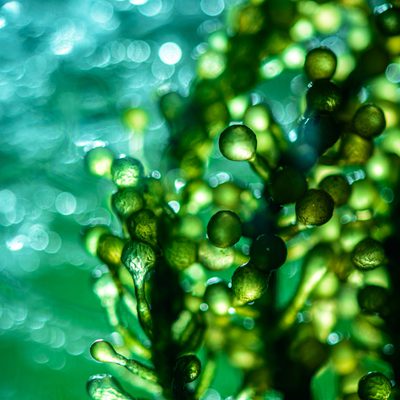
DHA originates in algae. Specifically, in certain microalgae that produce it as part of their normal biology. Fish accumulate DHA by eating those algae, or by eating smaller fish that have eaten those algae. The DHA in a fish oil capsule didn't start in the fish. It started in algae, passed through the marine food chain, and ended up in the fish.
When we make our Omega-3 supplement, we go directly to the original source. We grow microalgae in controlled conditions, no ocean, no fish, no contamination risk, and extract the DHA and EPA from there.
The end result in your capsule or dropper is chemically identical to what you'd get from fish oil. Same DHA. Same EPA. Same benefits. The fish is simply not involved.
So why does this matter?
A few reasons, depending on what you care about.
For vegans and vegetarians, the obvious point is that algae-derived Omega-3 contains no animal products at any stage of its production. Our Omega-3 is Vegan Society approved, not just because the capsule doesn't contain fish, but because the ingredient itself comes from a non-animal source.
For those with fish allergies, algae oil is a genuinely fish-free alternative rather than a workaround. The DHA and EPA come from algae grown in a lab environment, completely separated from the marine food chain.
For anyone thinking about purity, it's worth knowing that fish oil can carry trace contaminants from the ocean environment, heavy metals and other compounds that accumulate in marine animals. Algae grown in controlled laboratory conditions doesn't carry those concerns.
And for anyone thinking about sustainability, the global fish oil industry processes large volumes of wild-caught fish every year. Algae-derived Omega-3 sidesteps that entirely.
What about ALA, the Omega‑3 in flaxseed and walnuts?
This comes up a lot, and it's worth being honest about.
ALA (alpha-linolenic acid) is an Omega-3 fatty acid found in plant foods like flaxseed, chia seeds, hemp seeds, and walnuts. It's genuinely good for you and worth including in your diet.
The issue is that ALA is not the same thing as DHA or EPA. The body can convert ALA into EPA and DHA, but this conversion is slow and varies a lot between individuals. Research suggests that for most people, the conversion rate is low, meaning that eating plenty of flaxseed doesn't reliably translate into the DHA levels your brain needs.
Algae-derived Omega-3 provides DHA and EPA directly, bypassing the conversion step entirely. That's a meaningful practical difference for anyone relying primarily on plant foods.
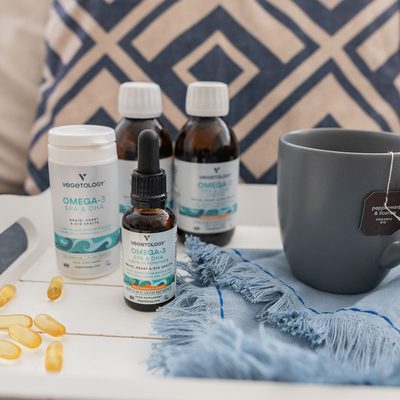
The Vegetology Omega‑3 range
All four products start from the same place: microalgae grown in controlled conditions, providing DHA and EPA without any fish in the process.
Omega-3 EPA & DHA capsules — 300mg EPA and 500mg DHA per serving. Two capsules a day. Simple.
Liquid, no added flavour — the same EPA and DHA in liquid form, unflavoured for mixing into food or drink.
Liquid, mild orange flavour — same again, with a light orange flavour if you prefer it.
Liquid Concentrate — 150mg EPA and 300mg DHA per 1ml in a dropper bottle, with Vitamin D3 included. The most concentrated option, and suitable for the whole family including children and babies.
If I'm honest with you, the algae question is one we find genuinely exciting rather than just commercially convenient. The fish was always the middleman. We just made him redundant.


The gut-brain axis isnt woo
"Gut-brain connection" sounds like wellness-aisle hand-waving. It isn't. There's a literal nerve, a…
Why curcumin needs black pepper
Curcumin, the active compound in turmeric, is famously hard to absorb. A pinch of black pepper chan…
B12 isn't really about being vegan. It's about your gut.
B12 deficiency gets blamed on plant-based diets. But absorption is a gut story, not a vegan one. He…
Brain fog, poor focus, and low mood, the nutritional angle most people overlook
Brain fog, poor focus, and low mood often have a nutritional explanation and DHA, Lion's Mane, B12,…