
Plant-based collagen doesn’t actually exist. Here’s what does.
"Vegan collagen" is a contradiction in terms. Collagen is an animal protein, full stop. But the honest version of the story is better than the marketing one, because it explains how every collagen supplement actually works, animal or not.
Let's start with two words you won't find anywhere on our label: "vegan collagen."
Collagen is an animal protein. It's the most abundant protein in your body, and in every other animal's body, and it doesn't occur in plants. So "vegan collagen" is, strictly speaking, a contradiction, there's no collagen in it, because there can't be. That's exactly why we named ours Vollagen®, and didn't slap "vegan collagen" on the front.
Here's the thing, though: everyone else calls the whole category vegan collagen anyway, and it's what people type into a search bar. We're not going to be precious about the word when you use it, it's genuinely the easiest way to say "a vegan alternative that gives your body the raw materials to make its own collagen." What matters isn't whether you call it vegan collagen. It's whether the brand selling it to you is honest about what's really in the pot and how it works. Plenty aren't.
So let's do the honest version. It's more useful and, once you get it, more reassuring.
What a collagen supplement is actually doing (even the animal ones)
Here's the bit the whole category quietly relies on you not thinking about too hard.
When you swallow a collagen supplement, any collagen supplement, marine, bovine, whatever your gut does not politely forward it to your face. Your digestive system takes that protein and dismantles it, the same way it dismantles a steak or a lentil, into its component amino acids and short peptides. Those get absorbed into your bloodstream as building blocks. Your body then decides, entirely on its own terms, what to build with them.
In other words, nobody is "putting collagen into" their skin by eating it. You are supplying raw material and hoping your body uses some of it to make its own collagen. That's true whether the raw material came from a cow or a cornfield.
Once you know that, the whole "but is it real collagen" question rather deflates. Real collagen gets demolished on the way in regardless. What matters is whether the amino acids arriving at the other end are the right ones, in the right proportions.
What “hydrolysed collagen” is and why it quietly proves the point
If you've shopped for collagen, you've met the wordhydrolysed (you'll also see "collagen peptides" or "collagen hydrolysate" same thing). It sounds technical and premium. All it really means is that the collagen has been broken into smallerpieces before it ever goes in the pot, using water and enzymes. Pre-chewed, basically.
Why would a brand pre-demolish its own hero ingredient? Because whole collagen is a big, tough molecule your gut absorbs poorly. Chopping it into short peptides and amino acids makes it dissolve and absorb far better. And that's the tell: the animal-collagen industry hydrolyses its collagen for exactly the reason we've been describing, it's the small pieces, not the intact collagen, that your body can use. Hydrolysing is just a factory doing, in advance, what your gut would do anyway.
One honest complication, because we don't do tidy oversimplifications. There's some emerging research that a handful of specific collagen peptides may survive digestion intact and act as little signals, nudging your cells to make more collagen, rather than serving purely as raw material. It's a genuinely interesting question, and an unsettled one: the research is early, largely industry-funded, and a long way from conclusive. We're watching it. And either way, if you don't eat animal products, it's beside the point, which is rather why a plant-based option exists.

What we actually make
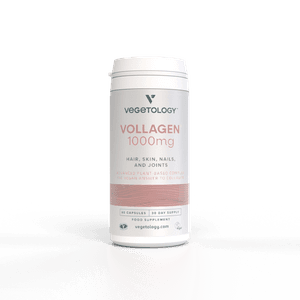
Vollagen® is our answer to all this and, as the name quietly signals, we didn't call it "vegan collagen." What it honestly is: a complex of 18 amino acids, produced by fermentation using non-GMO corn as the starting material, formulated to mirror the amino acid profile found in human collagen, glycine, proline and hydroxyproline doing the heavy lifting, because those three are the ones collagen is unusually rich in.
A daily 1000mg dose (two capsules) delivers those amino acids in roughly the proportions your body would want them for collagen-building. No animal involved, no ocean involved, no middleman being digested first. You're skipping the "eat an animal's collagen, break it down, reabsorb the pieces" detour and just providing the pieces.
Is that better than animal collagen? For the amino-acid-supply job, it's doing the same job by a shorter route. For the "I would rather not eat a cow" job, it's the only route. What it very much is not is a worse imitation of the real thing because, as we've just established, the real thing gets turned into these same building blocks anyway.
Building blocks aren’t the whole story and this is where it gets geeky
Here's the part that separates people who understand collagen from people who just buy it.
Amino acids are the bricks. Your body still has to lay them, and to lay collagen properly it needs a specific tool: vitamin C.
This isn't a wellness talking point, it's enzymology. Two enzymes — prolyl hydroxylase and lysyl hydroxylase, if you want to be precise — do an essential step in collagen assembly, and both of them physically cannot work without vitamin C as a cofactor. No vitamin C, no proper hydroxylation, no stable collagen. This is, incidentally, the actual biochemistry behind scurvy: the classic sailor's disease was collagen synthesis grinding to a halt for want of a bit of citrus. The gums go first because they're remodelling collagen constantly.
The authorised EU health claim reflects exactly this: vitamin C contributes to normal collagen formation for the normal function of skin. That one made it through the regulators, precisely because the mechanism is beyond dispute.
Which sets up a fact worth being upfront about: Vollagen contains no vitamin C. It's a clean amino acid complex, nothing bolted on. So the bricks are covered; the tool that lays them is a separate question.
Which is why Vollagen and MultiVit are a genuine pair, not a bundle upsell
We could have added a token dusting of vitamin C to Vollagen and called it a "complete collagen system." We didn't, because that's the kind of move this brand exists to avoid.
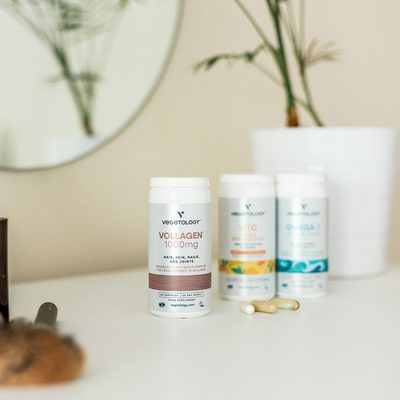
Instead: if you want the building blocks and the cofactor that puts them to use, our MultiVit carries vitamin C at 100% of your daily requirement (alongside zinc, biotin and selenium, which have their own authorised skin, hair and nail claims — but that's the next blog). Vollagen supplies the amino acids. MultiVit supplies the vitamin C your body uses to build with them. That's not us inventing a reason to sell you two things, it's two genuinely different jobs, and we'd rather name them honestly than fake one product that pretends to do both.
If you already eat plenty of fruit and veg, your vitamin C is probably handled and Vollagen alone makes sense. If you're not sure, the pairing closes the gap. Either way, now you know why.
About the “clinically proven” claims you’ll see on collagen everywhere
A quick honesty note, because this whole blog is about not overclaiming.
There is research on Vollagen's amino acid complex, including a study reporting firmer, more hydrated skin and a reduction in fine lines over 60 days. We think that's genuinely encouraging. We'd also point out that skin studies are notoriously hard to run cleanly, small groups, subjective measures, and the awkward fact that being in a skin study makes people drink more water and take better care of themselves. So we'll say "promising," we'll happily show you the study, and we won't pretend a supplement is a facelift. If a brand's collagen claims sound too good to be scientific, they usually are.
The takeaway
"Vegan collagen" is a handy name for something that, strictly, can't contain collagen and that's fine. Call it what you like; it's what everyone searches for anyway. The brands to swerve aren't the ones using the word, they're the ones implying it's identical to collagen, or quietly leaving out the vitamin C that makes any of it work. What actually exists is this: the amino acid building blocks of collagen, from fermentation instead of an animal, plus the vitamin C your body needs to assemble them.
Vollagen is the building blocks. Vitamin C, in your diet or supplement, or in MultiVit, is the tool. Your body does the building. That's the honest mechanism, and it's the same mechanism whether the amino acids started life in a cow or in corn.
We just picked the version that doesn't involve the cow.


Your skin barrier is mostly fat. What that means for omega-3s.
Your skin's outer barrier is built largely from lipids. That sounds like an open-and-shut case for …
The gut-brain axis isnt woo
"Gut-brain connection" sounds like wellness-aisle hand-waving. It isn't. There's a literal nerve, a…
Why curcumin needs black pepper
Curcumin, the active compound in turmeric, is famously hard to absorb. A pinch of black pepper chan…
B12 isn't really about being vegan. It's about your gut.
B12 deficiency gets blamed on plant-based diets. But absorption is a gut story, not a vegan one. He…