Your skin barrier is mostly fat. What that means for omega-3s.
Your skin's outer barrier is built largely from lipids. That sounds like an open-and-shut case for omega-3s but the honest version of the science is more interesting, and less convenient, than the one on most supplement labels.
We've talked before about the brain being roughly 60% fat by dry weight, and what that means for the fats you eat. Your skin runs a version of the same trick, for an entirely different reason.
The outermost layer of your skin — the stratum corneum, the bit you can actually touch — is often described as bricks and mortar. The bricks are flattened, dead skin cells. The mortar holding them together is fat. That greasy matrix is doing something genuinely impressive: it is the reason you don't dry out like a leaf, and the reason most of what lands on your skin stays outside of you.
So: skin barrier, mostly fat. Take fat supplements, get better skin. Case closed.
Except it isn't, and the real answer is more interesting.
What the mortar is actually made of
The lipid matrix between those cells isn't one substance. It's three families working together: ceramides, cholesterol, and free fatty acids. They stack into ordered layers, and the ordering matters as much as the ingredients. Get the proportions wrong and the barrier leaks, water escapes outwards, irritants get in, and the skin behaves the way dry, reactive skin behaves.
This is why barrier-repair skincare tends to feature ceramides. It's also why stripping your skin with something aggressive and then wondering why it feels tight is a self-inflicted wound. You removed the mortar.
Here's the part that gets skipped.
The fatty acid your barrier is genuinely built around isn’t an omega‑3
It's linoleic acid — an omega-6.
Linoleic acid gets built into a specialised class of lipids called acylceramides, which are essentially the waterproofing layer of the whole system. The classic evidence here isn't subtle: deprive an animal of linoleic acid and the skin becomes scaly and loses water at a dramatic rate. Give it back and the barrier recovers. It's one of the cleaner cause-and-effect stories in skin biology.
Which is a slightly awkward fact for a supplement brand to put in a blog about omega-3s. We're putting it in anyway, because the alternative is telling you something that isn't true.
The good news for you, and the reason nobody sells a linoleic acid supplement: most people eating a normal diet get plenty of it. It's abundant in nuts, seeds and seed oils. Linoleic acid is rarely the missing piece in a British diet. It's essential, and it's already handled.
So if omega-3 isn't the mortar, what is it doing?
Where EPA and DHA actually turn up
Not in the mortar. Underneath it.
Below that dead outer layer sit living cells, and those cells build their membranes out of whatever fatty acids you've been eating. EPA and DHA get incorporated there, and more interestingly, they're the raw material for a family of signalling molecules involved in how inflammation resolves. Not how it starts. How it stops.
That's the mechanism worth understanding. Your body doesn't just switch inflammation off like a light; it actively produces compounds that bring the process to an orderly close, and some of those compounds are built from omega-3s. Which is why omega-3 status keeps appearing in research on inflammatory skin conditions.
Keeps appearing in research is not the same as proven, and this is where we have to be straight with you.
The bit most brands leave out
In the UK and EU, the authorised health claims for EPA and DHA are heart function, brain function and vision. That's it. There is no authorised claim for omega-3 and skin, not because regulators haven't noticed the research, but because the evidence hasn't yet met the bar they set.
So when you see omega-3 sold as a skincare supplement, with a serene photo and a promise about your complexion, that brand is running ahead of the evidence. The science is genuinely promising and genuinely unfinished. Both halves of that sentence are true, and dropping the second half is how the supplement industry got its reputation.
What we'd say instead: take omega-3 for the things it's actually established to do. If your skin benefits, that's a reasonable hope rather than a promise we're prepared to print on a label.
That's a less exciting pitch. It's also the only one we can defend.
What we make, and why it comes from algae
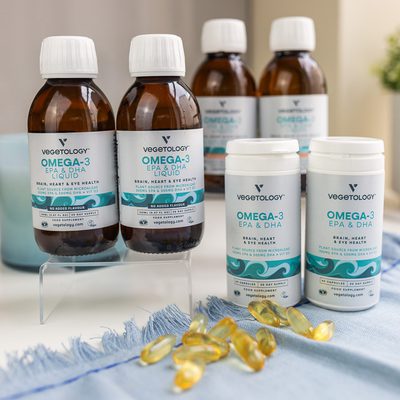
Our Vegan Omega-3 delivers 300mg EPA and 500mg DHA per daily serving of two capsules, from Schizochytrium microalgae grown in tanks at a pharmaceutical-quality facility.
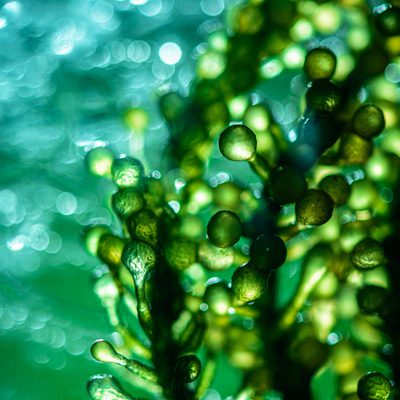
The algae bit isn't a workaround for vegans, and it's worth knowing why. Fish don't manufacture EPA and DHA. They accumulate them by eating algae, which is where the molecules are actually made. Fish oil is the middleman, a middleman that also brings along whatever else was in the ocean that week, plus the taste. Going to algae directly means going to the source, skipping the ocean's contaminant load, and skipping the burps.
Same molecules. Considerably shorter supply chain.
The takeaway
Your skin barrier is mostly fat, and that's real. The specific fat it's built around is linoleic acid, which you're probably already getting, and that's real too.
Omega-3s work on a different layer of the problem, the living cells underneath, and the signalling that governs how inflammation winds down. That's a mechanism with genuine promise attached and an incomplete evidence base, and anyone claiming more certainty than that is selling rather than explaining.
Take your omega-3 for your heart, your brain and your eyes. Those claims are settled. Treat anything it does for your skin as a bonus the science hasn't finished checking.

Plant-based collagen doesn't actually exist. Here's what does.
"Vegan collagen" is a contradiction in terms. Collagen is an animal protein, full stop. But the hon…
The gut-brain axis isnt woo
"Gut-brain connection" sounds like wellness-aisle hand-waving. It isn't. There's a literal nerve, a…
Why curcumin needs black pepper
Curcumin, the active compound in turmeric, is famously hard to absorb. A pinch of black pepper chan…
B12 isn't really about being vegan. It's about your gut.
B12 deficiency gets blamed on plant-based diets. But absorption is a gut story, not a vegan one. He…