
Everything You Need To Know About Vitamin D
Did you see in the headlines recently about the health concerns surrounding Vitamin D in the UK? Public Health England has revised its guidelines to recommend that most people take a Vitamin D supplement, after discovering most of us aren’t getting enough Vitamin D. We asked Chris Smith, co-founder of Vegetology and resident science geek, to give us the lowdown on Vitamin D. Why is it so important, why are we not getting enough and what can we do to change that?Did you catch the recent headlines about Vitamin D and health in the UK? Public Health England has updated its guidance, now recommending that most people take a Vitamin D supplement after finding widespread deficiency across the population. We asked Chris Smith, co-founder of Vegetology and resident science geek, to give us the lowdown: why is Vitamin D so important, why aren’t we getting enough, and what can we do about it?
What is Vitamin D?
Often called the sunshine vitamin, Vitamin D plays a crucial role in almost every part of the body. “It’s essential for healthy bones and teeth as it helps us absorb and retain calcium,” explains Chris. “It’s also needed for muscle function, heart and cardiovascular health, brain development, and the immune system.”
New research continues to uncover even more benefits — from supporting asthma management to potential roles in treating Alzheimer’s disease.
How Do We Get Vitamin D?
We can get small amounts of Vitamin D from food, but it’s often minimal or fortified. “Red meats and oily fish such as tuna or mackerel contain Vitamin D. Some cereals, fruit juices, and cheeses do too, but only because they’ve been fortified,” says Chris. “So while food can help, levels are usually very low.”
The best-known source? Sunshine. When UVB rays hit the skin, a chemical reaction occurs that produces Vitamin D naturally. “That’s how the body is designed to make it,” explains Chris. “However, in the UK, we simply don’t get enough sun — especially from September to March.”
In fact, if you live north of 52° latitude (roughly north of Milton Keynes), you’re unlikely to get enough sunlight year-round to maintain adequate Vitamin D levels.

Why Vitamin D deficiency is a problem
A prolonged lack of Vitamin D affects the body in many ways. “Because Vitamin D is vital for bones and teeth, deficiency can lead to weak or brittle bones, achiness, creaky joints, and muscular weakness,” says Chris. “We’ve even seen cases of rickets return in the UK in the 21st century.”
The impact goes beyond the skeleton. Low Vitamin D levels are linked to cardiovascular disease, diabetes, frequent infections, and mood disorders such as depression and seasonal affective disorder. “A common complaint from people low in Vitamin D is feeling exhausted all the time,” Chris adds.

Do Vitamin D supplements work?
There are two main forms of Vitamin D: D2 (ergocalciferol) and D3 (cholecalciferol).
“It’s really important to understand the difference,” says Chris.
“Vitamin D3 is the form your body naturally produces when exposed to the sun. It’s ready to be absorbed, metabolised, and used. Vitamin D2, on the other hand, comes from plant sources like mushrooms, but it has to go through extra conversions before it’s useful. D3 is widely accepted as the more effective form.”
Vitamin D and a plant-based diet
Traditionally, Vitamin D3 supplements were derived from lanolin (sheep’s wool grease) or fish oil, making them unsuitable for vegetarians and vegans. As a result, plant-based supplements often relied on Vitamin D2 — which, as Chris notes, isn’t as effective.
Thankfully, science has advanced. “After a lot of research, there’s now a plant source of Vitamin D3 available,” Chris explains. “It comes from lichen — a moss-like organism — so it ticks every box for vegetarians and vegans. In short, Vitamin D2 is redundant. It won’t disappear, but there’s really no reason to take it anymore.”
Introducing our Vit D3
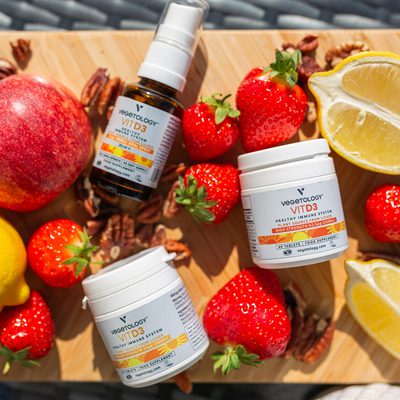
Our Vit D3 (previously known as Vitashine) is 100% plant-sourced Vitamin D3, approved and certified by both the Vegan Society and the Vegetarian Society. It’s available in two convenient formats — tablets at different doses, and an oral spray ideal for families.
“The tablets are great for those wanting a higher dose, while the spray can be used by everyone with flexible dosing based on age,” says Chris.
How much Vitamin D do you need?
If you’re unsure about your Vitamin D levels, start by asking your GP for a test. “Vitamin D testing is usually free or low-cost,” Chris notes. “If you’re deficient, you may be prescribed a high dose for a short time to rebuild your stores, followed by a maintenance dose.”
Vitamin D isn’t just another supplement — it’s a cornerstone of overall health, affecting everything from your bones and muscles to your mood and immunity. With sunlight scarce in the UK for much of the year and dietary sources often limited, supplementation has become a practical, science-backed solution. Thanks to advances in plant-based nutrition, everyone — including vegetarians and vegans — can now access effective Vitamin D3 without compromise.
“Don’t wait until you feel the effects of deficiency,” Chris reminds us. “Test your levels, take the right form of Vitamin D, and give your body the support it truly needs.” Your bones, your heart, and even your energy levels will thank you.


The gut-brain axis isnt woo
"Gut-brain connection" sounds like wellness-aisle hand-waving. It isn't. There's a literal nerve, a…
Why curcumin needs black pepper
Curcumin, the active compound in turmeric, is famously hard to absorb. A pinch of black pepper chan…
B12 isn't really about being vegan. It's about your gut.
B12 deficiency gets blamed on plant-based diets. But absorption is a gut story, not a vegan one. He…
Brain fog, poor focus, and low mood, the nutritional angle most people overlook
Brain fog, poor focus, and low mood often have a nutritional explanation and DHA, Lion's Mane, B12,…