
The calcium myth — why taking calcium alone won’t protect your bones
Calcium alone isn't enough for healthy bones — it needs Vitamin D3 to be absorbed and Vitamin K2 to direct it into bone rather than soft tissue, though whether you need all three from a supplement depends on what your diet already provides.
Calcium supplements have been mainstream for over sixty years. Everyone knows calcium is good for your bones. Generations of people have taken calcium tablets as a matter of course - often on the advice of a doctor, a parent, or a friend who was told the same thing.
So here's a question that ought to be more uncomfortable than it is: if we've been supplementing calcium for six decades, why have bone fracture rates continued to rise across that same period?
The answer isn't that calcium doesn't matter. It does. The answer is that calcium alone is only part of the story - and the rest of the story doesn't get nearly enough attention.
What calcium actually needs to work
When you take a calcium supplement, what happens next isn't automatic. Two things need to go right before that calcium ends up in your bones.
First, it needs to be absorbed. Your gut doesn't just soak up everything that passes through it. Calcium absorption depends heavily on having enough Vitamin D3 - because D3 is what allows your gut to actually take calcium in. Without enough D3, a significant chunk of the calcium you swallow simply passes through. This is why the NHS and the European Food Safety Authority both recognise Vitamin D as essential for normal calcium absorption - it's not a marketing claim, it's how the body works.
Second, once it's been absorbed, the calcium needs to go to the right place. And this is where most calcium supplements fall down.

K2: the part most people have never heard of
Vitamin K2 is probably the least famous vitamin in the bone health conversation. Which is a shame, because it's doing something really important.
Think of calcium as a delivery that needs to reach the right address. Vitamin D3 gets it into the bloodstream. But Vitamin K2 is what makes sure it ends up in your bones and teeth, rather than drifting around in your soft tissue.
It does this by activating proteins that specifically draw calcium into bone. Without enough K2, the calcium that's been absorbed has less direction - and your bones may not get the benefit you're hoping for.
This is why, when you look at the research on calcium and bone health, the studies that combine calcium with both D3 and K2 consistently tell a better story than the ones looking at calcium alone. The three nutrients work together, each one making the others more effective.
We call it the Triangle Effect.
Our Calcium + Vit D3 + K2 tablets
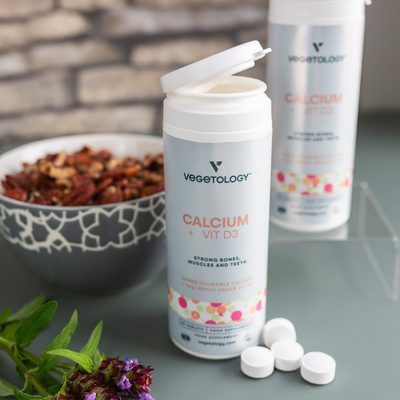
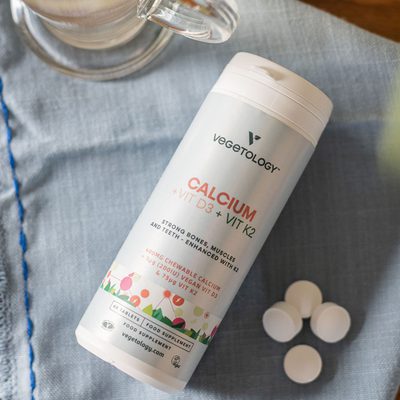
Our Calcium + Vit D3 + K2 supplement is built around exactly this idea. Each chewable tablet provides 400mg of calcium, 5µg of plant-source Vitamin D3, and 75µg of Vitamin K2.
It's a chewable format - which makes it much easier to take than a standard large tablet, and means it's suitable for anyone who finds swallowing supplements difficult. One tablet a day. That's it.
If you're looking for broader bone and joint support alongside your calcium - including glucosamine, Phytodroitin™, and magnesium - our Bone Care formula covers all of those in a single product.
Who should think about this?
The short answer is: most people, at most life stages.
In your teens and twenties, your bones are still building density. The habits you establish now genuinely affect your bone health decades later.
In your thirties and forties, bone mass starts to plateau and then gradually decline. This is when maintenance becomes the focus.
Over fifty - and particularly for women after the menopause, when bone density can decrease more rapidly - getting enough calcium, D3, and K2 becomes more important, not less. The NHS recommends 700mg of calcium per day from all sources; many people, especially those avoiding dairy, don't get there.
The good news is that this is one of those areas where a simple, consistent habit makes a real difference. You don't need to do anything complicated.
A note on Calcium + D3
A question worth addressing directly: if K2 is so important, what about supplements that combine calcium with D3 but not K2?
The honest answer is that it depends on your diet. K2 is found naturally in fermented foods - natto (a Japanese fermented soybean dish) contains particularly high levels - as well as some aged cheeses and fermented dairy products. People who eat these regularly may have a decent dietary K2 intake already, in which case a Calcium + D3 combination may cover what they need from a supplement.
For most people in the UK though - and particularly those eating a plant-based diet, where fermented animal products aren't on the menu - dietary K2 tends to be low. In that context, a supplement that includes all three nutrients is likely to be more complete.
If you're already taking a Calcium + D3 supplement and eating a varied diet that includes some fermented foods, you may be doing fine. If you're plant-based, or if fermented foods aren't a regular part of your diet, it's worth considering whether K2 belongs in the picture too.

The plant-based case
If you eat a plant-based diet, the calcium picture is worth understanding clearly. Many plant foods contain calcium - kale, broccoli, fortified oat milk, tofu made with calcium salts - but hitting 700mg a day consistently from food alone takes some doing. And unlike dairy, most plant-based sources don't come with D3 or K2 attached.
The good news is that this is one of those areas where a simple daily supplement makes a genuinely complete difference. Calcium, D3, and K2 together - whether through our Calcium + Vit D3 + K2 tablets or as part of the broader formula in Bone Care - covers the full picture in one habit.
No compromises on ingredients. No animal derivatives. Just the three nutrients your bones actually need, from sources that align with how you eat.




Brain fog, poor focus, and low mood, the nutritional angle most people overlook
Brain fog, poor focus, and low mood often have a nutritional explanation and DHA, Lion's Mane, B12,…
Fish oil vs algae oil, what's actually different (and what isn't)
Algae oil and fish oil contain the same DHA and EPA molecules, because fish don't make it themselve…
Your brain is 60% fat. Here's what that actually means.
Your brain is built from fat, specifically DHA and here's what that actually means for why Omega-3 …
Calcium is Only Half the Story
Why bone health needs three nutrients working together, not one working alone