
Running, cycling, or sitting at a desk all day — what your joints actually need
Whether you run, cycle, or sit at a desk all day, your joints need consistent nutritional support — and the window to start is well before anything starts hurting.
There's a persistent assumption about joint supplements. That they're for older people. For people who've already developed problems. For people whose knees make a noise on the stairs.
I get where it comes from. Joint health advertising has always leaned heavily towards the 60+ bracket. The imagery tends to be a certain vintage. The language usually involves the word "mobility" in a fairly specific way.
But the research doesn't really support the "wait until something hurts" approach. The conditions that eventually show up as joint discomfort often build quietly over years, sometimes decades before they become noticeable. Cartilage, in particular, doesn't have its own blood supply, which means it heals more slowly than most other tissues. Looking after it before you have a reason to is a more sensible strategy than it might sound.
What does vary is what your joints actually need and that depends quite a lot on how you use them.
If you run or cycle
Runners and cyclists put sustained, repetitive load through specific joints. For runners, the knees and hips take most of the impact. For cyclists, the knee movement is different but continuous, and long rides often load the lower back in ways that aren't immediately obvious.
Two things are happening simultaneously in people who train regularly.
The first is wear on cartilage. Cartilage is the smooth tissue that cushions the ends of your bones where they meet at a joint. It's remarkably good at handling load over a lifetime - but it's not indestructible, and years of high-impact repetitive movement without adequate recovery can gradually affect the quality of that cushioning. This is where glucosamine and Phytodroitin™ are relevant - not as treatments for damage, but as support for the ongoing maintenance process.


The second is inflammation. Exercise is naturally inflammatory - and that's not a bad thing. The mild inflammation triggered by a hard workout is part of how your body adapts and gets stronger. The issue is when the body doesn't get enough recovery time for that inflammation to fully settle. Over weeks and months, that low-level background inflammation can start to affect how joints feel.
This is where Omega-3 comes in. The EPA component of Omega-3 fatty acids plays a well-documented role in helping the body regulate its inflammatory response. Research looking specifically at joint health has found that people taking Omega-3 supplements report meaningful improvements in joint comfort compared to those who don't - and the mechanism makes sense.
Our Vegan Omega-3 Liquid Concentrate delivers 150mg EPA and 300mg DHA in just 1ml via a simple dropper - which makes it genuinely easy to take every day. No capsules to swallow, no large dose of oil. Just a small daily drop that can go straight in the mouth or into a smoothie.
If you work at a desk
Desk work presents a completely different kind of joint challenge - and one that tends to get far less attention than the sports-related conversation.
Here's the thing about sitting for long periods: it's not passive. Your hip flexors are working to hold you in that position. Your lower back is absorbing a load it wasn't really designed for. The discs between your vertebrae - which rely on movement to stay properly hydrated and healthy - aren't getting the activity they need. Your glutes, which normally share the load with your lower back, gradually switch off.
Most people with desk jobs will recognise some version of this: the stiffness that sets in by mid-afternoon, the lower back that protests after a long day, the hips that feel tight when you finally stand up. Large-scale research consistently shows that spending more hours sitting is linked to higher rates of lower back pain and hip discomfort. Which makes intuitive sense once you understand what's happening in the body.

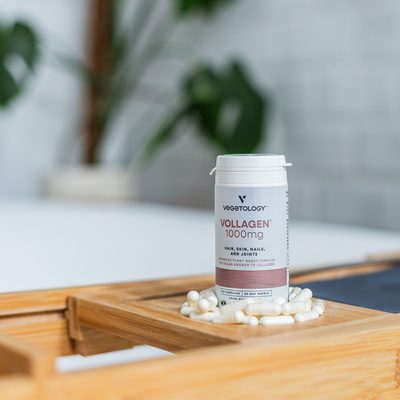
For people in this situation, collagen is particularly worth thinking about. Collagen is the protein that holds together your cartilage, tendons, and ligaments - essentially the scaffolding of your joints.
Your body makes collagen naturally, but it needs the right raw materials to do so, and Vitamin C is a big part of that. It's one of the reasons Vitamin C is included in Bone Care alongside the glucosamine and Phytodroitin™.
If you want to go further on the collagen front, Vollagen® is worth knowing about. It's a vegan collagen supplement - not animal-derived collagen, but the amino acids that make up collagen, in the same proportions they're found naturally, from 100% plant sources. Your body uses them to build its own collagen where it needs it most. For desk workers dealing with joint stiffness or connective tissue discomfort, it pairs well with Bone Care as part of a complete daily routine.
The Omega‑3 point, for everyone
If there's one thing that applies equally to people who run marathons and people who sit at computers all day, it's this: most people in the UK aren't getting enough Omega-3.
Those who eat oily fish a few times a week are doing better, but still often fall short of what research suggests is useful for joint health. Those on a plant-based diet are starting from an even lower baseline, because the Omega-3 found in plant foods like flaxseed and walnuts comes in a form the body has to convert before it can use - and that conversion is slow and inefficient for most people.
Algae-derived Omega-3 - like the kind in our Vegan Omega-3 Liquid Concentrate - bypasses that conversion step entirely. It's the same EPA and DHA your body actually uses, coming directly from the source. No fish involved. No fishy taste. And a format flexible enough for the whole family, including children.
The short version
Looking after your joints isn't something to think about when things start going wrong. It's something that pays off when you start early - regardless of whether you're training for a race or just trying to get through a working week without your back complaining.
The approach doesn't need to be complicated. Consistent, simple support - through what you eat and a few well-chosen supplements - is enough to make a real difference over time.



Brain fog, poor focus, and low mood, the nutritional angle most people overlook
Brain fog, poor focus, and low mood often have a nutritional explanation and DHA, Lion's Mane, B12,…
Fish oil vs algae oil, what's actually different (and what isn't)
Algae oil and fish oil contain the same DHA and EPA molecules, because fish don't make it themselve…
Your brain is 60% fat. Here's what that actually means.
Your brain is built from fat, specifically DHA and here's what that actually means for why Omega-3 …
Calcium is Only Half the Story
Why bone health needs three nutrients working together, not one working alone