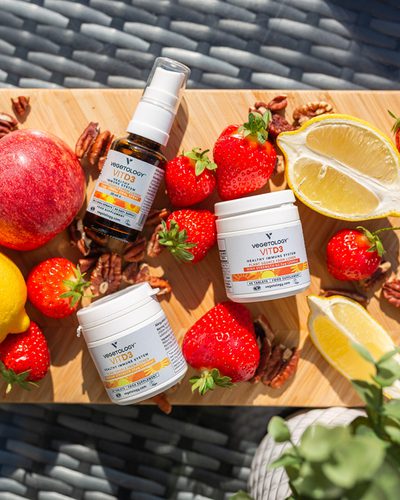
The NHS recommends 10 micrograms of vitamin D daily. That is roughly 400iu. It is the official baseline, and for a healthy adult who gets a reasonable amount of sunlight through spring and summer, it is a fair place to start.
But here is the thing about baselines: they are designed to cover the minimum, not to optimise. And for a significant chunk of the population, 400iu is not nearly enough to make a meaningful difference to their vitamin D status.
I wonder how many people are taking a standard-dose supplement faithfully every day, and still spending their winters in that foggy, flat, vaguely rundown state that can be hard to put your finger on, but feels suspiciously like their body is not firing on all cylinders.
If that resonates, it might be time to think about strength. And possibly about what goes alongside your D3 as well.
Who actually needs a higher dose?
Vitamin D deficiency is not rare. It is remarkably, surprisingly common, particularly in the UK, where latitude, cloud cover, and the rhythms of indoor modern life conspire against the whole sunlight-on-skin model that our vitamin D production depends on.
Certain groups are especially likely to have lower levels:
People who spend most of their day indoors. Office workers, remote workers, carers, people with health conditions that limit outdoor time. If your skin isn't regularly seeing strong sunlight, your body is producing very little D3 on its own.
People with darker skin. Melanin (the pigment that gives skin its colour) naturally filters UVB rays. That is protective against sun damage, but it also reduces the amount of UVB that triggers vitamin D synthesis. Research suggests people with darker skin may need up to 3-5 times longer sun exposure to produce the same amount of D3 as those with lighter skin.
Older adults. The skin's ability to synthesise vitamin D declines with age. At the same time, the kidneys become less efficient at converting vitamin D into its active form. This combination means older people frequently need more vitamin D supplementation to maintain adequate levels.
Those in northern latitudes. If you are in Manchester, Glasgow, or anywhere in between, UVB rays are at an angle too low to trigger significant vitamin D synthesis for roughly half the year. October to March, the sun simply cannot do the job, regardless of how much time you spend outside.
People who have been tested and found to be deficient. The most straightforward case of all. If a blood test has confirmed low vitamin D levels, a maintenance dose is unlikely to shift them significantly. A higher-strength supplement, taken consistently over several months, is what actually moves the needle.
For any of the above, a 2500iu or 4000iu supplement is not overkill. It is appropriate.
Why we chose baobab for our high-strength formulas
Our 4000iu vitamin D3 chewables (both the standalone formula and the D3+K2 version) are formulated with baobab. We get asked about this, and it is a genuinely good question.
Baobab is the fruit of the Adansonia digitata tree, which grows across sub-Saharan Africa. The Baobab has been called the Tree of Life, and it lives up to the name. These trees can stand for over a thousand years, and the fruit they produce is extraordinary. Unlike most fruit, baobab dries naturally on the branch, which means by the time it is harvested, the pulp is already concentrated and shelf-stable, with no processing required.
Nutritionally, baobab is remarkable. It is one of the most concentrated natural sources of vitamin C in the world: up to 227mg of vitamin C per 100g, roughly six to ten times more than oranges. It is also almost 50% fibre, a significant proportion of which is prebiotic, supporting a healthy gut microbiome. And it contains meaningful amounts of potassium, magnesium, iron, and calcium.
For a vitamin D3 supplement specifically, the vitamin C content is particularly relevant. Vitamin D3 is fat-soluble, meaning it is best absorbed alongside food and other nutrients. Vitamin C, meanwhile, is a powerful antioxidant that supports immune function, overlapping neatly with one of vitamin D3's primary roles. Including baobab in the formula is not a marketing decision. It is a sensible one.
It also makes the chewable taste considerably better than a plain tablet. Which should not be underestimated as a reason to actually take it.

Nutritionally, baobab is remarkable. It is one of the most concentrated natural sources of vitamin C in the world: up to 227mg of vitamin C per 100g, roughly six to ten times more than oranges. It is also almost 50% fibre, a significant proportion of which is prebiotic, supporting a healthy gut microbiome. And it contains meaningful amounts of potassium, magnesium, iron, and calcium.
For a vitamin D3 supplement specifically, the vitamin C content is particularly relevant. Vitamin D3 is fat-soluble, meaning it is best absorbed alongside food and other nutrients. Vitamin C, meanwhile, is a powerful antioxidant that supports immune function, overlapping neatly with one of vitamin D3's primary roles. Including baobab in the formula is not a marketing decision. It is a sensible one.
It also makes the chewable taste considerably better than a plain tablet. Which should not be underestimated as a reason to actually take it.
The K2 question: why your D3 needs a co-pilot

Here is something that does not come up nearly often enough in conversations about vitamin D. Your body's ability to absorb calcium is one thing. What happens to that calcium once it enters your bloodstream is another. This is where vitamin K2 becomes genuinely important.
Vitamin D3 dramatically increases your gut's ability to absorb calcium. At adequate D3 levels, absorption rises to around 30-40%. That is exactly what you want for supporting bone density and muscle function. The problem is that increasing calcium absorption without directing that calcium properly leaves open a question that sounds slightly alarming when you first encounter it: where does all that extra calcium go?
The answer, without sufficient vitamin K2, is: not always where you want it to.
Vitamin K2 (particularly the MK-7 form, which is the most bioavailable and longest-acting) activates two key proteins in the body. The first is osteocalcin, which acts as a kind of anchor, binding calcium into the bone matrix and increasing bone mineral density. The second is matrix Gla protein (MGP), which helps prevent calcium from depositing in arteries and soft tissues, places where you really do not want it building up.
A 2025 study published in Scientific Reports found that patients receiving combined K2 and D3 supplementation had a significantly higher rate of successful bone fusion compared to those receiving D3 alone: 91% versus 71% at six months. Earlier work has shown that combining the two vitamins is more effective for improving bone mineral density than either taken separately. The mechanism is well understood and the research, while still expanding, points consistently in the same direction.
The analogy that makes most sense to me is this: vitamin D3 is the delivery driver, getting calcium to your door. Vitamin K2 is the logistics system that ensures it ends up in the right room (your bones) rather than left in the middle of the hallway (your arteries).
This is why our 4000iu + K2 formula exists. At higher D3 levels, this relationship becomes particularly relevant. If you are supplementing with 4000iu of D3 daily on a long-term basis, it makes good nutritional sense to support your body's calcium management at the same time.
Vitamin K2 (particularly the MK-7 form, which is the most bioavailable and longest-acting) activates two key proteins in the body. The first is osteocalcin, which acts as a kind of anchor, binding calcium into the bone matrix and increasing bone mineral density. The second is matrix Gla protein (MGP), which helps prevent calcium from depositing in arteries and soft tissues, places where you really do not want it building up.
A 2025 study published in Scientific Reports found that patients receiving combined K2 and D3 supplementation had a significantly higher rate of successful bone fusion compared to those receiving D3 alone: 91% versus 71% at six months. Earlier work has shown that combining the two vitamins is more effective for improving bone mineral density than either taken separately. The mechanism is well understood and the research, while still expanding, points consistently in the same direction.
The analogy that makes most sense to me is this: vitamin D3 is the delivery driver, getting calcium to your door. Vitamin K2 is the logistics system that ensures it ends up in the right room (your bones) rather than left in the middle of the hallway (your arteries).
This is why our 4000iu + K2 formula exists. At higher D3 levels, this relationship becomes particularly relevant. If you are supplementing with 4000iu of D3 daily on a long-term basis, it makes good nutritional sense to support your body's calcium management at the same time.
What does K2 deficiency look like, practically?
Vitamin K2 is found in fermented foods, particularly natto, a traditional Japanese fermented soybean dish, and to a lesser extent in certain cheeses and fermented vegetables. Most people in the UK, including those eating a broadly varied diet, consume relatively little of it. Vegans, who typically have no access to natto and limited cheese intake, may be especially low.
K2 deficiency is not dramatic in the way that, say, severe vitamin C deficiency presents. It is more a question of calcium being handled less efficiently over time. Bones not mineralising as well as they could, arterial flexibility that gradually becomes more of an issue. It is a quiet problem rather than a loud one, which is partly why it tends to get less attention than it deserves.
The high-strength range at a glance
If you have got this far and are wondering where you sit, here is a practical summary.
The Vit D3 2500iu chewable is a solid everyday choice for people who spend most of their day indoors, want more than the basic maintenance dose, or simply want to feel more confident about their vitamin D levels through the darker months.
The Vit D3 4000iu chewable is designed for those who need a more robust top-up, whether because of confirmed deficiency, very limited sun exposure, or the cumulative effect of living somewhere that doesn't get reliable sunshine year-round.
The Vit D3 4000iu + K2 chewable is the most complete bone health formula in our range. If you are supplementing at 4000iu for the long term, or you want to support your body's calcium management alongside your D3 intake, this is the one to look at.
All three are vegan (derived from lichen, not lanolin) and certified by both the Vegan Society and the Vegetarian Society. That has always been the baseline at Vegetology, not a footnote.

A word on testing
If you are thinking about moving to a higher-strength supplement and have not had your vitamin D levels checked, it is worth doing. A simple blood test (available privately or sometimes through your GP) gives you your serum 25-hydroxyvitamin D concentration, which tells you exactly where you stand. The threshold for deficiency is generally taken as below 25 nmol/L; optimal levels for most adults sit somewhere between 50 and 125 nmol/L.
Knowing your number takes the guesswork out of supplementation. It also makes it much easier to track whether what you are doing is actually working. For something you are taking every day, that seems worth knowing.
The bottom line
Vitamin D3 supplementation is not complicated. But choosing the right strength, and understanding what works best alongside it, is worth a few minutes of thought. Not everyone needs 4000iu. But quite a few people who have been getting by on 400iu, wondering why they still feel low in autumn, might find the answer is simpler than they expected.
And for those who do step up to higher strength: taking it with K2 is not an extra complication. It is just the fuller picture of how these nutrients are designed to work together.
Plant-based, properly formulated, without compromise. That's what we do. It's in our nature.


The gut-brain axis isnt woo
"Gut-brain connection" sounds like wellness-aisle hand-waving. It isn't. There's a literal nerve, a…
Why curcumin needs black pepper
Curcumin, the active compound in turmeric, is famously hard to absorb. A pinch of black pepper chan…
B12 isn't really about being vegan. It's about your gut.
B12 deficiency gets blamed on plant-based diets. But absorption is a gut story, not a vegan one. He…
Brain fog, poor focus, and low mood, the nutritional angle most people overlook
Brain fog, poor focus, and low mood often have a nutritional explanation and DHA, Lion's Mane, B12,…